





CMA’s Recommendations on the 2026 Policy Address
The Hong Kong Chinese Manufacturers’ Association (CMA) recently submitted a supplementary proposal to the HKSAR Government for the 2026 Policy Address, following its submission of the CMA’s Proposal for the Five-Year Plan in June. The proposal sets out nearly 70 policy measures covering a broad range of areas, including innovation and technology, new industrialisation, the development of the Northern Metropolis, the establishment of a high-value-added supply chain management centre, branding, new growth drivers, green and ESG initiatives, and support for SMEs.
CMA President Dr Wingco Lo said that 2026 marks the first year of the national 15th Five-Year Plan and the first year of implementation of Hong Kong’s first Five-Year Plan. As such, this year’s Policy Address is not only about setting annual policy priorities, but also a crucial starting point for turning the city’s blueprint into action. He added that all sectors of society should seize this opportunity to strengthen Hong Kong’s momentum for future growth.
Building on the 170 broad directions set out in the CMA’s Proposal for the Five-Year Plan, the supplementary document further identifies and refines a number of policies that could be implemented over the coming year to deliver early results, while also proposing additional measures to support short-term Five-Year Plan objectives. The CMA hopes these proposals will provide the HKSAR Government with practical, actionable suggestions that support Hong Kong’s long-term development.
Key recommendations include:
Strengthen the innovation ecosystem: The Government should establish a dedicated application channel under the Innovation and Technology Fund to support corporate technology adoption and transfer projects. R&D centres under the Innovation and Technology Commission should place greater emphasis on common technologies and collaborate with industry to accelerate commercialisation. Intellectual property platforms should be integrated, with AI used to enhance matching and advisory services. Fiscal and tax incentives should be strengthened, for example by introducing computing power vouchers and raising the tax deduction for R&D expenditure to 400% for the first HK$2 million, to support R&D and SME technology adoption. The financial sector should also be encouraged to develop IP pledge financing products. In addition, a fund should be established to support non-profit-making organisations in setting up pilot production platforms for SMEs.
Promote new industrialisation: The Government should publish the Hong Kong Industrial Development Blueprint as soon as possible, balancing support for emerging industries with traditional strengths. It should also introduce a GNI-oriented statistical approach to better reflect the contribution of Hong Kong manufacturers operating outside the city. The Government should consider establishing a Hong Kong version of the “specialised, sophisticated, distinctive and innovative” enterprise standard to support SME upgrading. Food and health industries should be prioritised in the Northern Metropolis, and a site study and concept plan for a Hong Kong Food Technology Park should be launched. In addition, the listing and financing regime should be improved to support quality technology companies and start-ups, while stronger links between vocational education and industry, as well as the development of the applied sciences university system, should be accelerated.
Accelerate Northern Metropolis development: Support the Government in expanding the university town in the Northern Metropolis, recommend drawing on the Shenzhen model to promote cross-campus collaboration and stronger university-community integration, while attracting institutions from local, Mainland and overseas. The Government should also expand exhibition and convention facilities, publish a list of priority investment opportunities, and bring in experienced park developers as strategic partners. The Hong Kong Investment Corporation Limited (HKIC) should help channel patient capital alongside market funds to speed up industrial park development. In addition, leading tech firms should be encouraged to set up collaborative innovation platforms and pilot manufacturing facilities in San Tin Technopole should be supported through land and incentives. Pilot schemes should be launched to facilitate cross-boundary data flow.
Build a high-value-added supply chain management centre: The Government should review the HKSAR’s overseas office network and establish additional ETOs in South America, Central Asia and Vietnam. Financial institutions should be encouraged to provide targeted financing for “going global” enterprises, while more Hong Kong–Mainland business delegations should be organised to explore emerging markets. Fiscal and tax incentives should be introduced to help companies upgrade supply chain management through technology, and a one-stop platform should be set up to match Mainland enterprises with professional services in Hong Kong. Support should also be provided for chambers of commerce and organisations to invite overseas business leaders to Hong Kong for exchanges. In addition, an index for an international supply chain management centre should be developed, along with a regular competitiveness ranking, to strengthen Hong Kong’s global profile.
Deepen branding efforts: The Government should refresh and strengthen the “Hong Kong brand” image. Dedicated “Hong Kong Brands” sections should be established on major e-commerce platforms, and “Hong Kong brand first” should be incorporated into government procurement policies. The Government should also explore the use of geographical indication marks for industries with strong local characteristics, and promote the “Brand Greater Bay Area” initiative to strengthen the region’s brand identity.
Promote bulk commodity trade: The gold clearing system should be further enhanced, and more RMB-denominated gold products developed. The half-rate tax concession for bulk commodity traders should be extended to warehousing, logistics and supply chain service providers. Cooperation with Mainland commodity exchanges should also be strengthened to extend market connectivity into the bulk commodity sector.
Create new growth drivers: The Government should develop the yacht economy, streamline arrangements for Hong Kong yachts travelling north and Guangdong yachts travelling south, and fully unlock the industrial chain potential of yacht manufacturing and related services. Industry-tourism integration should be further promoted as a core tourism strategy. Local halal certification and international mutual recognition should be advanced to help businesses capture opportunities in halal markets. The silver economy should be strengthened through a list of age-friendly products and services. Blue carbon development should also be linked to the upgrading of fisheries and agriculture in the Northern Metropolis, including modern aquaculture, leisure fisheries and agriculture, and a blue carbon accounting system.
Support SMEs: The BUD Fund should continue to support the local market while easing geographical restrictions to cover overseas markets. The Digital Transformation Support Pilot Programme should be opened to all SMEs. A one-stop approach should be adopted to speed up licensing approvals for rural tourism, while street-stall culture should be upgraded. The Government should also explore an enhanced “Incentive Scheme for Recurrent Exhibitions 3.0” and extend it to more venues. Efforts should be made to revitalise and commercialise intangible cultural heritage (ICH), including through “ICH + tourism” and a register and map of Hong Kong’s legacy brands.
Promote green development and ESG practices: A cross-departmental task force should be set up to coordinate ESG efforts and help the industry respond to the EU’s Carbon Border Adjustment Mechanism (CBAM). A local carbon audit and carbon labelling system should be developed, and ESG professional services should be strengthened. Fiscal and tax incentives should be introduced to encourage SMEs to adopt ESG practices, while trade associations should be supported in carrying out related research, training and promotion.
Deepen GBA integration: The arrangements of “allowing Hong Kong-invested enterprises to adopt Hong Kong law” and “allowing Hong Kong-invested enterprises to choose for arbitration to be seated in Hong Kong” should be extended to more Mainland provinces and cities. CEPA facilitation measures for the sale of Chinese proprietary medicines in the GBA should be expanded nationwide, and extended to Chinese medicine and health products. More GBA standards should be developed, with priority given to sectors where Hong Kong has strengths, and SMEs should receive guidance and subsidies to help reduce compliance costs. The Government should also seek support from Mainland authorities to simplify customs procedures for goods displayed and sold by Hong Kong traders in the Mainland, expand the cross-boundary e-commerce whitelist and transaction limits, and relax customs restrictions on travellers entering the Mainland via Hong Kong who carry Mainland-regulated food in reasonable quantities for personal use.
Encl:
Full document of CMA’s suggestions for the 2026 Policy Address
Full document of CMA’s suggestions for Hong Kong Five-Year Plan
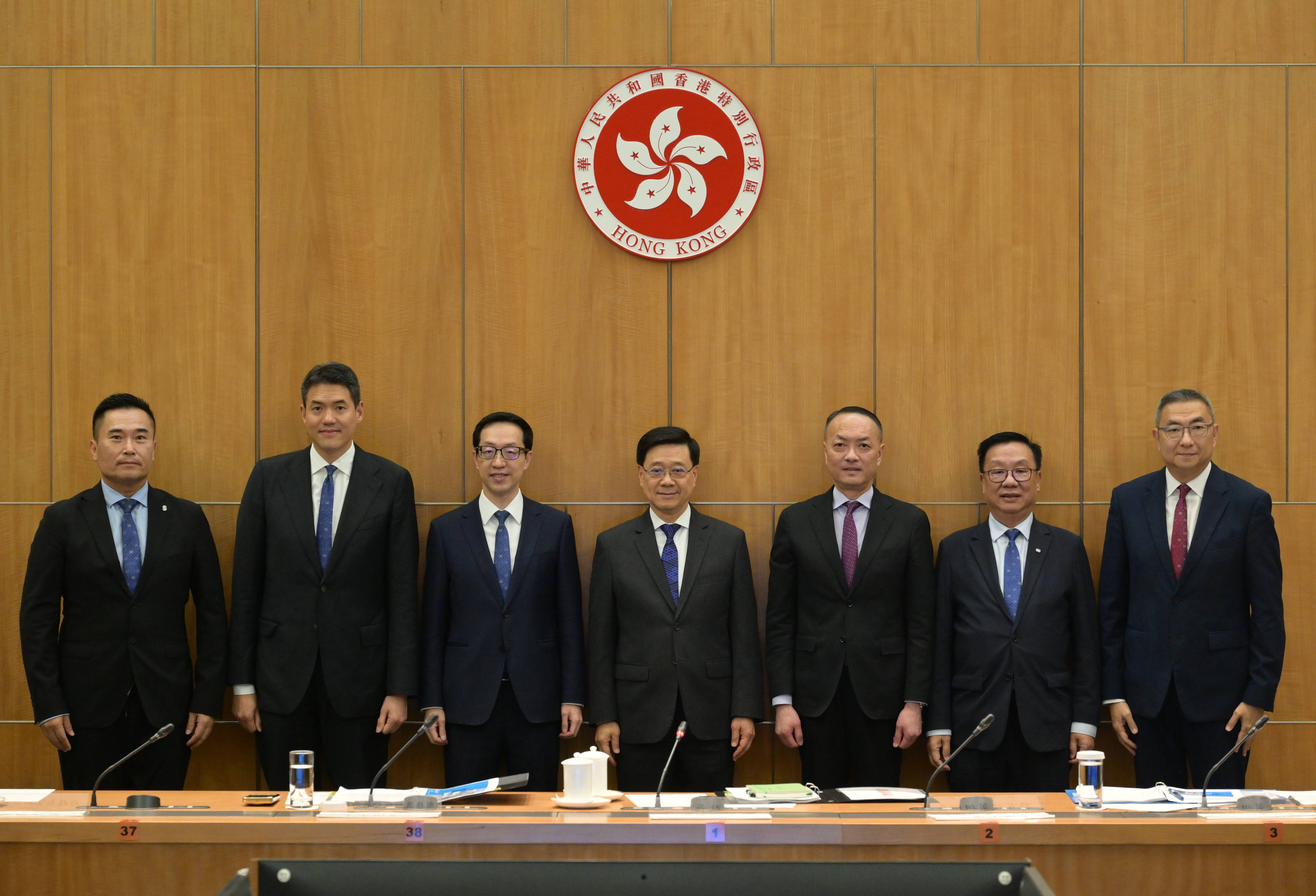
CMA office-bearers shared the CMA’s suggestions for the 2026 Policy Address with Chief Executive Mr John Lee
CMA President Dr Wingco Lo said that 2026 marks the first year of the national 15th Five-Year Plan and the first year of implementation of Hong Kong’s first Five-Year Plan. As such, this year’s Policy Address is not only about setting annual policy priorities, but also a crucial starting point for turning the city’s blueprint into action. He added that all sectors of society should seize this opportunity to strengthen Hong Kong’s momentum for future growth.
Building on the 170 broad directions set out in the CMA’s Proposal for the Five-Year Plan, the supplementary document further identifies and refines a number of policies that could be implemented over the coming year to deliver early results, while also proposing additional measures to support short-term Five-Year Plan objectives. The CMA hopes these proposals will provide the HKSAR Government with practical, actionable suggestions that support Hong Kong’s long-term development.
Key recommendations include:
Strengthen the innovation ecosystem: The Government should establish a dedicated application channel under the Innovation and Technology Fund to support corporate technology adoption and transfer projects. R&D centres under the Innovation and Technology Commission should place greater emphasis on common technologies and collaborate with industry to accelerate commercialisation. Intellectual property platforms should be integrated, with AI used to enhance matching and advisory services. Fiscal and tax incentives should be strengthened, for example by introducing computing power vouchers and raising the tax deduction for R&D expenditure to 400% for the first HK$2 million, to support R&D and SME technology adoption. The financial sector should also be encouraged to develop IP pledge financing products. In addition, a fund should be established to support non-profit-making organisations in setting up pilot production platforms for SMEs.
Promote new industrialisation: The Government should publish the Hong Kong Industrial Development Blueprint as soon as possible, balancing support for emerging industries with traditional strengths. It should also introduce a GNI-oriented statistical approach to better reflect the contribution of Hong Kong manufacturers operating outside the city. The Government should consider establishing a Hong Kong version of the “specialised, sophisticated, distinctive and innovative” enterprise standard to support SME upgrading. Food and health industries should be prioritised in the Northern Metropolis, and a site study and concept plan for a Hong Kong Food Technology Park should be launched. In addition, the listing and financing regime should be improved to support quality technology companies and start-ups, while stronger links between vocational education and industry, as well as the development of the applied sciences university system, should be accelerated.
Accelerate Northern Metropolis development: Support the Government in expanding the university town in the Northern Metropolis, recommend drawing on the Shenzhen model to promote cross-campus collaboration and stronger university-community integration, while attracting institutions from local, Mainland and overseas. The Government should also expand exhibition and convention facilities, publish a list of priority investment opportunities, and bring in experienced park developers as strategic partners. The Hong Kong Investment Corporation Limited (HKIC) should help channel patient capital alongside market funds to speed up industrial park development. In addition, leading tech firms should be encouraged to set up collaborative innovation platforms and pilot manufacturing facilities in San Tin Technopole should be supported through land and incentives. Pilot schemes should be launched to facilitate cross-boundary data flow.
Build a high-value-added supply chain management centre: The Government should review the HKSAR’s overseas office network and establish additional ETOs in South America, Central Asia and Vietnam. Financial institutions should be encouraged to provide targeted financing for “going global” enterprises, while more Hong Kong–Mainland business delegations should be organised to explore emerging markets. Fiscal and tax incentives should be introduced to help companies upgrade supply chain management through technology, and a one-stop platform should be set up to match Mainland enterprises with professional services in Hong Kong. Support should also be provided for chambers of commerce and organisations to invite overseas business leaders to Hong Kong for exchanges. In addition, an index for an international supply chain management centre should be developed, along with a regular competitiveness ranking, to strengthen Hong Kong’s global profile.
Deepen branding efforts: The Government should refresh and strengthen the “Hong Kong brand” image. Dedicated “Hong Kong Brands” sections should be established on major e-commerce platforms, and “Hong Kong brand first” should be incorporated into government procurement policies. The Government should also explore the use of geographical indication marks for industries with strong local characteristics, and promote the “Brand Greater Bay Area” initiative to strengthen the region’s brand identity.
Promote bulk commodity trade: The gold clearing system should be further enhanced, and more RMB-denominated gold products developed. The half-rate tax concession for bulk commodity traders should be extended to warehousing, logistics and supply chain service providers. Cooperation with Mainland commodity exchanges should also be strengthened to extend market connectivity into the bulk commodity sector.
Create new growth drivers: The Government should develop the yacht economy, streamline arrangements for Hong Kong yachts travelling north and Guangdong yachts travelling south, and fully unlock the industrial chain potential of yacht manufacturing and related services. Industry-tourism integration should be further promoted as a core tourism strategy. Local halal certification and international mutual recognition should be advanced to help businesses capture opportunities in halal markets. The silver economy should be strengthened through a list of age-friendly products and services. Blue carbon development should also be linked to the upgrading of fisheries and agriculture in the Northern Metropolis, including modern aquaculture, leisure fisheries and agriculture, and a blue carbon accounting system.
Support SMEs: The BUD Fund should continue to support the local market while easing geographical restrictions to cover overseas markets. The Digital Transformation Support Pilot Programme should be opened to all SMEs. A one-stop approach should be adopted to speed up licensing approvals for rural tourism, while street-stall culture should be upgraded. The Government should also explore an enhanced “Incentive Scheme for Recurrent Exhibitions 3.0” and extend it to more venues. Efforts should be made to revitalise and commercialise intangible cultural heritage (ICH), including through “ICH + tourism” and a register and map of Hong Kong’s legacy brands.
Promote green development and ESG practices: A cross-departmental task force should be set up to coordinate ESG efforts and help the industry respond to the EU’s Carbon Border Adjustment Mechanism (CBAM). A local carbon audit and carbon labelling system should be developed, and ESG professional services should be strengthened. Fiscal and tax incentives should be introduced to encourage SMEs to adopt ESG practices, while trade associations should be supported in carrying out related research, training and promotion.
Deepen GBA integration: The arrangements of “allowing Hong Kong-invested enterprises to adopt Hong Kong law” and “allowing Hong Kong-invested enterprises to choose for arbitration to be seated in Hong Kong” should be extended to more Mainland provinces and cities. CEPA facilitation measures for the sale of Chinese proprietary medicines in the GBA should be expanded nationwide, and extended to Chinese medicine and health products. More GBA standards should be developed, with priority given to sectors where Hong Kong has strengths, and SMEs should receive guidance and subsidies to help reduce compliance costs. The Government should also seek support from Mainland authorities to simplify customs procedures for goods displayed and sold by Hong Kong traders in the Mainland, expand the cross-boundary e-commerce whitelist and transaction limits, and relax customs restrictions on travellers entering the Mainland via Hong Kong who carry Mainland-regulated food in reasonable quantities for personal use.
Encl:
Full document of CMA’s suggestions for the 2026 Policy Address
Full document of CMA’s suggestions for Hong Kong Five-Year Plan
CMA office-bearers shared the CMA’s suggestions for the 2026 Policy Address with Chief Executive Mr John Lee